Last month in Brussels, Ukrainian leaders, NATO senior leaders, and Chiefs of Defence gathered to focus on security adaptation and the way ahead, with the war in Ukraine continuing to shape the Euro Atlantic security environment.
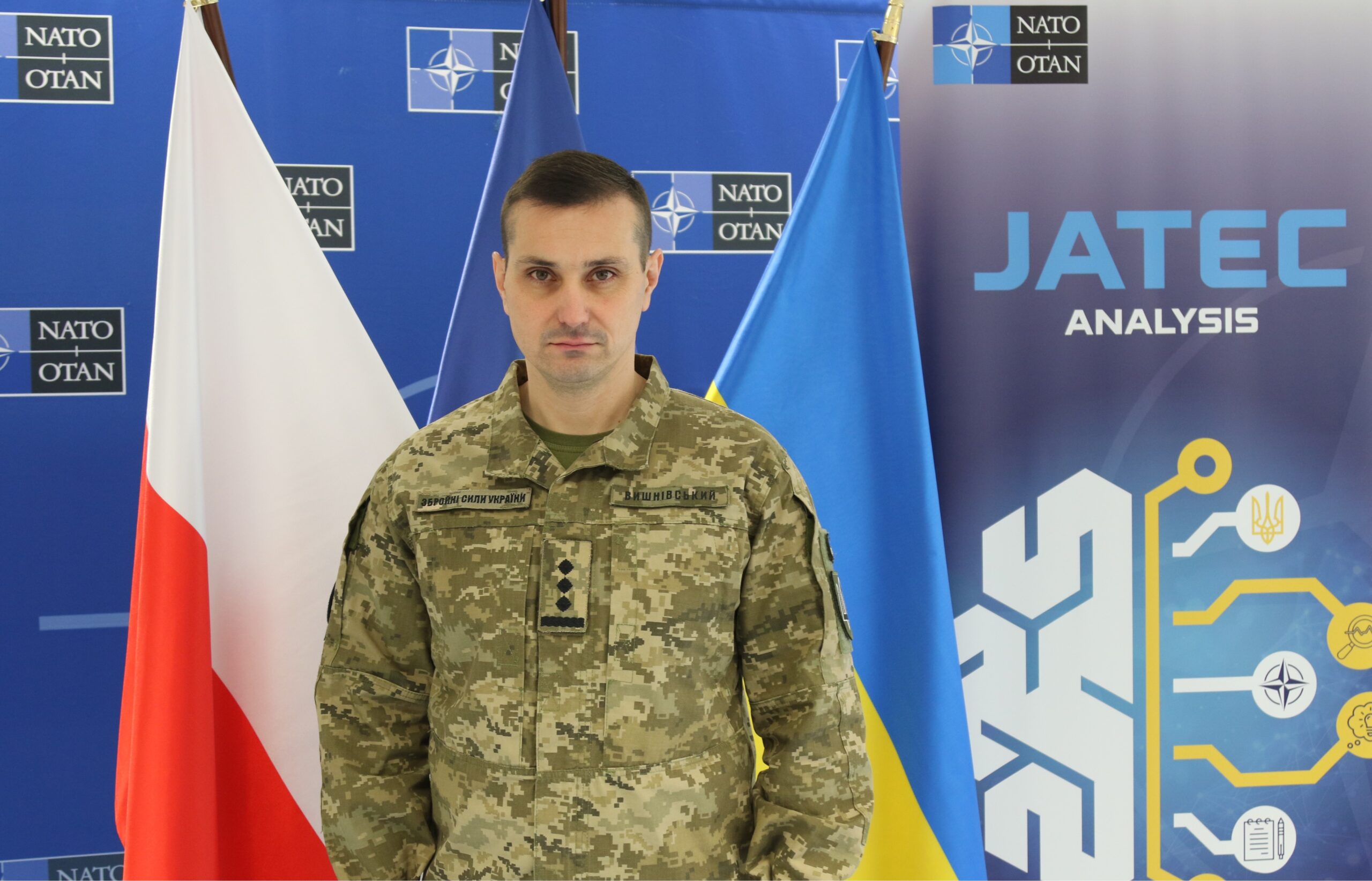
Alongside that wider engagement, Colonel Valerii Vyshnivskyi, the senior Ukrainian representative at NATO’s Joint Analysis Training and Education Centre (JATEC), offered a Ukrainian operational perspective that highlighted what the war demanded in practice: rapid learning, practical interoperability, and constant adaptation.
The human reality, and why JATEC exists
Colonel Vyshnivskyi frames the discussion through lived experience. When Russia’s full-scale invasion began, he was cooking dinner with his daughter. Hours later, missiles answered the question she had asked earlier that evening: could a real war begin in the 21st century? He evacuated his family to safety and returned to defend the city.
That immediacy continues to shape how he views NATO’s challenge. He describes himself as “living in this war,” carrying the war’s pace and pressures with him into every decision. That, he argues, is the value Ukrainian expertise brings into NATO’s adaptation and transformation cycles through JATEC.
JATEC, he notes, includes “20 Ukrainian experts in different areas,” working to translate frontline experience into doctrine, tactics, training, and capability development support that NATO can use.
The decisive factor is speed of adaptation
Colonel Vyshnivskyi’s central message is straightforward: the speed of adaptation is key in modern warfare.
Ukraine, he explains, is fighting a technologically sophisticated adversary in a multi domain environment, with all domains engaged simultaneously. In that environment, platforms, people, and command and control have to operate like an orchestra, coordinated as one system rather than as separate instruments.
For NATO, the implication is direct. Adaptation cycles measured in years are not fit for purpose. He argues that the pace has to move closer to “Ukrainian months, sometimes weeks.”
Interoperability is not optional, it is operational
The war also tested interoperability in the most unforgiving way possible: in combat, with mixed equipment, under real constraints.
Early in the war, he said, many asked how Ukraine could operate so many different types of equipment from different nations together. The answer emerged because it had to. Survival required it.
His conclusion points to a core requirement for any future force: “interoperability is not optional. Now it is a proven operational necessity.”
Systems become truly valuable when they are adapted and connected under one approach, allowing effects to be integrated across domains and combat effectiveness to multiply.
He also offers a caution. Interoperability should not be designed for peacetime convenience. It must be designed for combat friction.
People come first, technology follows as a multiplier
Despite the prominence of emerging technologies, Colonel Vyshnivskyi places the emphasis where he believes NATO ultimately succeeds or fails: people and the systems.
Asked what matters more, technology or people, his answer is immediate: people. Technology is created by humans and operated by humans. Education, training, and command and control come first. Technology then acts as a combat multiplier, not a substitute for understanding the mission and the operation.
Civil military integration functions as a combat multiplier
He also describes Ukraine’s resilience as broader than its armed forces alone.
Ukraine, he said, endures because civilian innovation, industry, defence activities, and strategic communication are integrated into “one instrument.”
Civilian and military efforts work together, absorb shock, sustain communication and continuity, and innovate under pressure.
For NATO, the lesson remains practical: civil military cooperation and innovation accelerated adaptation, broaden capacity, and strengthen combat effectiveness.
How JATEC translates experiences into usable NATO outputs
Colonel Vyshnivskyi describes Ukraine as a real-world test ground for innovation, while cautioning that not every battlefield observation can be transferred directly.
That is where he places JATEC’s role. It provides a mechanism to experiment, stress test, and validate technologies and observations in a safe environment, then connects insights with intelligence, logistics, and best practices. The goal is not simply to observe what happens on the battlefield, but to convert experience into improvements NATO can use to prepare for potential future conflict.